
207MAE: THERMOFLUID MECHANICS Assignment, CU, Singapore This laboratory exercise is to construct the vapor-compression refrigeration cycle on the pressure-enthalpy property diagram
| University | Coventry University (CU) |
This laboratory exercise is to construct the vapor-compression refrigeration cycle on the pressure-enthalpy property diagram for a refrigeration cycle demonstration unit and assess its thermal performance, which is the coefficient of performance.
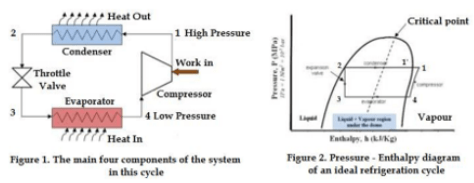
Students will identify the main component of the apparatus (i.4. condenser, evaporator, compressor and throttle expansion valve) and analyze the thermodynamic processes occurring within. Temperatures and pressures of the liquid and gas phases of the refrigerant at various locations (thermodynamic states) will be measured to construct the refrigeration cycle.
Theory for the vapor-compression cycle The vapor-compression cycle is the most commonly used refrigeration cycle and involves the same four processes as a heat engine cycle but in the reverse order (i.e. evaporation 4 compression 4 condensations .4 expansion throttling).
A schematic representation of the main components in this cycle is shown in Figure 1. The corresponding pressure-enthalpy diagram is shown in Fig. 2.
the temperature of the refrigerant increases during this isentropic compression process to well above the temperature of the strumming medium.
The refrigerant then enters the condenser as superheated vapor at the state I and leaves as a saturated liquid at state 2 as a result of heat rejection to the surroundings. The temperature of the refrigerant at this state is still above the temperature of the surroundings.
The saturated liquid refrigerant at state 2 is throttled to the evaporator pressure by passing it through an expansion valve or capillary tube. The temperature of the refrigerant drops below the temperature of the refrigerated space during this process. At the same time, the pressure is greatly reduced.
The refrigerant enters the evaporator at state 3 as a low-quality saturated mixture, and it completely evaporates by absorbing heat from the refrigerated space.
The refrigerant leaves the evaporator as saturated vapor (state 4) and re-enters the compressor, completing the cycle.
Procedure
The lab engineer will provide a briefing of the equipment before conducting the experiment.
identify cycle components, locate the transducers, selector switches of throttle type, and sub-cool setting.
2. Set pre-determined temperature setting, throttle type and sub-cool setting (on oft).
3. Turn on the main switch and the compressor will start. Nonce the Fan Coil unit will turn on automatically.
4. Allow the unit to rim for at least 15 – 20 minutes to reach approximate thermal equilibrium before any measurement is recorded. The time taken to stabilise will depend upon the local ambient conditions.
5. Record the temperature and pressure readings, as shown in Table 2. Three different sets of readings are to be collected.
Analysis and Report Writing
For each set of data,
I) sketch the refrigeration cycle on the R22 p-h diagram (o.a. from f3 or 4] in appendix) by marking the refrigerant temperatures recorded,
2) calculate an ideal reversed Carrot Refrigeration Cycle working between the same condenser and evaporator temperatures of the refrigeration cycle, 3) calculate the q, and /I of the compressor based on the cycle.
Hire a Professional Essay & Assignment Writer for completing your Academic Assessments
Writing essays on thermofluid mechanics requires a deep understanding of the principles and effective communication skills. At our assignment helper sg service, we specialize in providing top-quality essay writing assistance. Our experts are well-versed in thermofluid mechanics topics and will help you craft well-structured and insightful essays that showcase your knowledge and analytical abilities. Pay our experts and let us assist you in achieving excellence in your 207MAE course at CU. Trust us with your essays, and elevate your academic performance with our trusted assignment helper service in Singapore!

- Social and New Media Written Report (40%): Website Message and Method Analysis with Strategic Recommendations | Murdoch
- ENG235 AIoT End-of-Course Assessment July 2026: PowerGrid SG Smart Grid and Utilities Case | SUSS
- BME363 ChatEHR End-of-Course Assessment July 2026: Large Language Models in Clinical Care | SUSS
- IBM380 International Business Capstone Management Project: Research Paper and Slide Presentation Brief (BBA)
- BUS329 Single Index Model Group Assignment TS 2026: Beta, Alpha and Risk Decomposition | Murdoch University
- Social and New Media Website Revamp Proposal: Digital Strategy Design Document | Murdoch
- Mentoring: Theory and Practice Essay: Collaboration in Mentoring Relationships | Kaplan
- NUR5731 Foundations of Integrated Care Thematic Literature Review 2026 | NUS
- LOG309 Industry 4.0 Logistics Applications ECA July 2026 | SUSS
- BUS304 Accounting Theory and Accountability Group Case Study TJA 2026 | Murdoch University