
CVEN3501: Water Resources Engineering Assignment, AGU, Singapore The objective of the assignment is to use the spreadsheet package Microsoft Excel to investigate
| University | Australia's Global University (AGU) |
The objective of the assignment is to use the spreadsheet package Microsoft Excel to investigate the effect of changing boundary conditions on a simple rectangular isotropic and homogeneous confined aquifer, firstly without pumping and then including a groundwater pumping bore abstracting or injecting water. The assignment is based on the analysis of Frank and Reilly (1987).
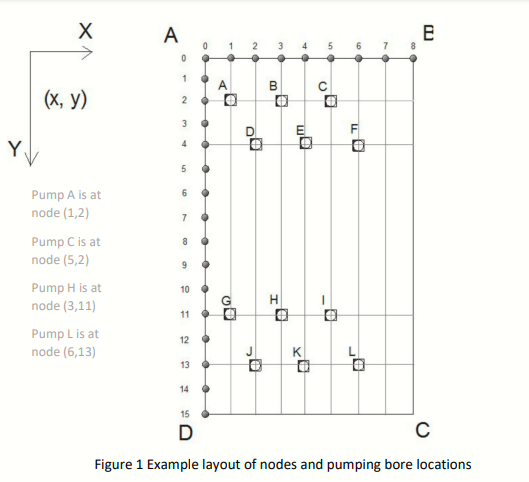
You should set up a model for your unique aquifer. Figure 1 is an example and does not necessarily match your aquifer dimensions. Your aquifer has an area X m wide (AB and CD) by Y m long (BC and DA). Use a finite difference discretisation where ∆x = ∆y = 100 m. Your model will then be X’ nodes wide in the x‐direction along boundaries AB and CD and Y’ nodes long in the y-direction along boundaries BC and DA.
In the example, the aquifer is X = 800 m wide by Y = 1500 m long and ∆x = ∆y = 100 m. This model, therefore, has X’ = 9 nodes in the x‐direction (from node 0 to node 8 along boundaries AB and CD) and Y’ = 16 nodes in the y‐direction (from node 0 to node 15 along boundaries BC and DA). See Figure 1.
Each student will have a unique set of data for the transmissivity, Pumping rate, initial head conditions (h [m]), and an x‐y coordinate pair representing the bore location. Find your data in the excel sheet on Moodle. Figure 1 shows how the bore location x‐y coordinate corresponds to a node in the numerical scheme.
For the spreadsheet to successfully iterate, circular references should be enabled. In Microsoft Excel 2010+ this is done under the menus: ”File” ‐ ”Options” ‐ ”Formulas”: Here you need to tick ”Enable iterative calculation”, set ”Maximum iterations” to 30,000, and ”Maximum change” to 0.0001.
Model the following two sets of aquifer conditions:
Model 1: The problem domain (aquifer) is surrounded by Dirichlet (fixed head) boundary conditions. Use a linear decrease in the head from hm to 0 m along with BC and AD, a fixed head of 0m along boundary CD, and a fixed head of h m along with boundary AB.
Model 2: The problem domain (aquifer) is surrounded by a mix of Dirichlet and Neumann (no flow) boundary conditions. Use a no‐flow boundary condition (with ∂h/∂x = 0) across BC and AD, a fixed head of 0 m along boundary CD, and a fixed head of h m along with boundary AB.
Stuck with a lot of homework assignments and feeling stressed ? Take professional academic assistance & Get 100% Plagiarism free papers
Excel in your Water Resources Engineering studies with expert assistance from our Homework Helper at Australia's Global University (AGU), Singapore! Whether you're working on individual assignments or your Final Year Project (FYP), our dedicated team is here to guide you through every step. Our Assignment Helper is well-versed in using Microsoft Excel to conduct in-depth investigations and analysis for CVEN3501: Water Resources Engineering. Don't let academic challenges hinder your progress – Singapore students can pay our experts to take help on their course and excel in their studies. Embrace academic success with our trusted online Homework Helper and assignment help services at AGU, Singapore
- ECE304 Supporting Diverse Learners Tutor-Marked Assignment 2026
- PSS304 Psychological Perspective to Public Safety Tutor Marked Assignment 01, 2026
- PAR301 Terrorism, CBRNE Incidents and Major Health Crises End-of-Course Assessment 2026
- SWK104 Human Growth and Life-Span Development (Birth to Adolescence) TMA 01, 2026
- ECE368 Childhood: Global Perspectives Tutor-Marked Assignment 2026
- HRM318 Human Capital Measurement Tutor-Marked Assignment 2026
- HRM333 Performance Management Tutor-Marked Assignment 2026
- LAW311 Criminal Law, Procedure and Evidence – 2 Tutor-Marked Assignment 2, 2026
- FMT317 SMART and Emerging Technologies for Facilities Management Tutor-Marked Assignment 01, 2026
- MGT301 Strategic Leadership and Collaboration Assessment Brief 2026