
MA4814 Computational Fluid Dynamics Assignment, NUS, Singapore Apply the finite volume technique to discretize and solve one-dimensional fully developed laminar
| University | National University of Singapore (NUS) |
• Learning Objectives
- Determine the criterion for grid convergence for a laminar one-dimensional channel flow
- Solve nonlinear one-dimensional channel flow for non-Newtonian fluid
Problem 1
Apply the finite volume technique to discretize and solve one-dimensional fully developed laminar flow between two horizontal parallel plates governed by
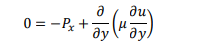
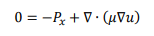
𝑢𝑢 is the velocity, 𝑃𝑃𝑥𝑥 is the pressure gradient and µ is the viscosity. In conservative form, this can be written as
Hire a Professional Essay & Assignment Writer for completing your Academic Assessments
In your solution show:
• A sketch for the cells, clearly marking faces and nodes for internal and boundary cells.
• Apply the linear approximation and use Dirichlet (velocity specified) boundary conditions to determine the approximate equations for internal and boundary cells.
• Compute the velocity distribution and compare your result with the exact solution, by adapting one of the uploaded codes. The number of grid cells is left up to you to determine. The solution must be grid converged.
For the numerical solution, let 𝑃𝑃𝑥𝑥 = 2µ, ℎ = 0.1, 𝑢𝑢(0) = 𝑢𝑢1 = 0.01, & 𝑢𝑢(ℎ) = 𝑢𝑢2 = 0. For grid convergence, you may define an error norm , and require that the error is less than 0.01𝑢 = 0.01 × 0.01. The exact solution is given by

Problem 2
Apply the finite volume technique to discretize and solve one-dimensional fully developed laminar non-Newtonian flow between two horizontal parallel plates governed by,
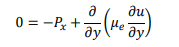
𝑢𝑢 is the velocity, 𝑃𝑃𝑥𝑥 is the pressure gradient. For non-Newtonian fluids, the viscosity µ𝑒𝑒 depends on the flow strain rate, which for one-dimensional fully developed flow is approximated by,
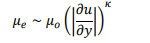
where 𝜇𝜇𝑜𝑜, 𝜅𝜅 are constants. Non-Newtonian fluids exist in several important applications, particularly in fluids using in printing, molten plastics used in 3D printers and most important for us, in blood and rheological flows. For more insight, you can check https://www.rheosense.com/applications/viscosity/newtonian-non-newtonian to learn more about
the shear thinning and thickening effects. As this is a non-linear problem, it is highly recommended
you follow the suggested algorithm:
Buy Custom Answer of This Assessment & Raise Your Grades
Empower your academic journey with our specialized services crafted for Singaporean students! At [Your Company Name], we excel in providing top-notch assignment help Singapore students trust. Whether you're navigating intricate subjects like Computational Fluid Dynamics at the National University of Singapore (NUS) or seeking assistance with Essay Writing Services and final year exam assignments, our expert team is at your service. When it comes to the MA4814 Computational Fluid Dynamics Assignment at NUS, we're here to help you apply the finite volume technique for one-dimensional fully developed laminar flow. Don't let academic challenges hold you back; trust our experts to ensure your success. Connect with us today and conquer your academic goals!

- NUR09714 Learning, Teaching and Assessment in Practice Summative Assessment | Edinburgh Napier University
- DSM020 Data Programming in Python Coursework: Exploratory Data Analysis | University of London
- DSM050 Data Visualisation Coursework 2, 2025 | University of London
- PSY201 Organisational Psychology End-of-Course Assessment, July 2026
- PSY201 Organisational Psychology Tutor-Marked Assignment 01, July 2026
- ICT239 Web Application Development End-of-Course Assessment July 2025
- HRM203 Human Behaviour in Organisations Tutor-Marked Assignment 01, 2025
- Introduction, Legal Writing and Research Assignment 2026: Separation of Powers and Singapore Courts
- HR9534 Resourcing and Development for Diversity Assessment Brief 2026
- GSS503 Navigating Risk in an Interconnected World Tutor-Marked Assignment 01, 2026